
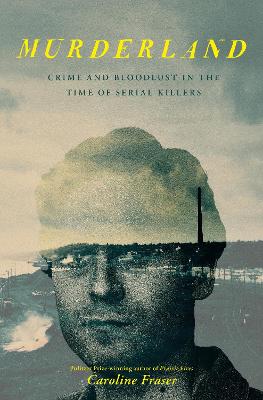
Temporarily out of stock
The Pacific Northwest is known for five things: lumber, aircraft, tech, coffee, and crime. Weyerhaeuser, Boeing, Microsoft and Amazon, Starbucks, and serial killers.
Pulitzer Prize-winning author Caroline Fraser grew up in the shadow of Ted Bundy, the most notorious serial murderer of women in American history, surrounded by his hunting grounds and mountain body dumps, in the brooding landscape of the Pacific Northwest. But in the 1970s and 80s, Bundy was just one perpetrator amid an uncanny explosion of serial rape and murder across the region. Why so many? Why so weirdly and nightmarishly gruesome? Why the senseless rise and then sudden fall of an epidemic of serial killing?
As Murderland indelibly maps the lives and careers of Bundy and his infamous peers in mayhem – the Green River Killer, the I-5 Killer, the Night Stalker, the Hillside Strangler, even Charles Manson – Fraser’s Northwestern death trip begins to uncover a deeper mystery and an overlapping pattern of environmental destruction. At ground zero in Ted Bundy’s Tacoma, stood one of the most poisonous lead, copper, and arsenic smelters in the world, but it was only one among many that dotted the area.
As Fraser’s investigation inexorably proceeds, evidence mounts that the plumes of western smelters not only sickened and blighted millions of lives, but also warped young minds, spawning a generation of serial killers. A propulsive non-fiction thriller, Murderland transcends true-crime voyeurism and noir mythology, taking readers on a profound quest into the dark heart of the real American berserk.
Format: Paperback
Pages: 480
Imprint: Fleet UK LBG
Publication date: 10/06/2025

Murderland
By Caroline Fraser
Review by Kazia
The premise of this book offered such intrigue that it fuelled a curiosity that demanded satiation; though I was honestly a bit sceptical going in. The implications to be drawn from Fraser’s interweaving narrative strike a disturbing picture. The idea that environmental degradation and interpersonal violence may be linked is not entirely new, and this book investigates the point with chilling frankness. Fraser points an accusing finger at corporate elites and does so without excusing violent individuals of their own blame.
The haunting revelations presented in this book pose an ever-relevant question: how much of the horrific violence that unfolded in this time and place was a consequence of the bloodied hands of capital? This exposition brutally highlights how the violence of capitalism breeds a much more personal type of violence, oozing into our psyches much the same way as our pollutants ooze into the environment. The result is toxicity nearly beyond comprehension, hidden in plain sight and leaving countless bodies in its wake. Fraser holds nothing back as she hammers into her readers a sharp point: to poison the land, the air, the waterways is to poison ourselves. Compelling and unsettling, this is a brilliant work of non-fiction.
For fans of true crime, ecological exposés or readers of The Forgotten Girls.